


Written by Bob Landry, executive director, ForgeWorks
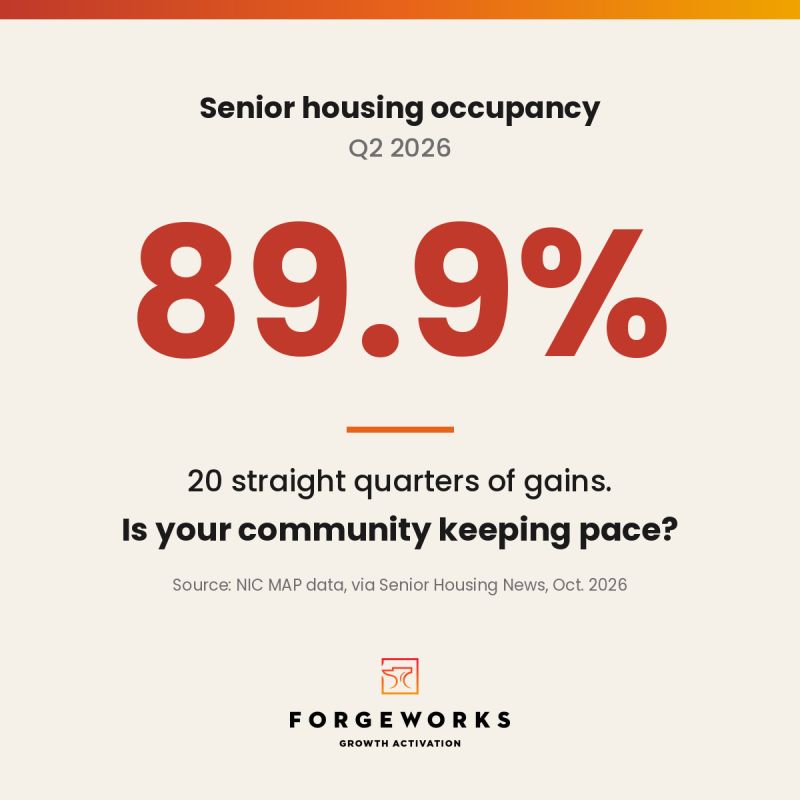
Here is a number worth considering: 89.9 percent. That was national senior housing occupancy in the second quarter of this year, according to NIC MAP data, the twentieth consecutive quarter of gains. By the third quarter, more than half of the 31 primary markets NIC tracks were averaging 90 percent or higher.
For most of the industry, that is good news. But it raises two very different questions, depending on how your community stands. If your occupancy is flat, why aren’t you full? And if you are full, with a waiting list and an expansion on the drawing board, will the people waiting be able to afford what you build?
In a market running near 90 percent, a demand explanation is hard to defend. The prospects exist, and many of them are already calling communities like yours. In our experience inside and alongside mission-driven senior living organizations, flat occupancy in a strong market is almost always an execution problem.
Many leaders describe the same frustration. Marketing is busy, with new ads, events on the calendar, and a steady stream of leads, yet the census barely moves. Leads and tours are activities. Move-ins are movements. When the gap between them is wide, the answer usually lies in three places.
Follow an inquiry from beginning to end. How quickly does someone call back? Is there a clear next step after a tour? In smaller communities, sales often rests on one or two people who also cover other roles, and follow-up slips when the week gets hard. Pull your last 50 inquiries and trace what happened to each one. The pattern will tell you more than any marketing report.
Pricing is where mission and market drift apart. Rates may sit below the market out of a genuine desire to stay accessible, or they may have risen without a clear story about the value families receive. Either way, if your counselors hesitate when a family asks about cost, that hesitation is costing you move-ins.
Families research, tour, consult children, and often wait for a health event before deciding. That gap can last months, and communities that win focus on that phase of the customer journey. They stay in touch, know where each family stands, and make it easy to come back. Measure how long your prospects take to move in and where they drop away. That is where occupancy can leak.
Many mission-driven communities face the opposite situation. They are full, the waiting list is long, and expansion looks like the obvious next step. Then the numbers arrive.
The cost of building has climbed dramatically. An Associated Builders and Contractors analysis of federal producer price data found that overall construction input costs rose 39.6 percent from February 2020 through late 2023. In senior living specifically, CBRE’s latest survey puts average development cost at $388,830 per unit, or $364 per square foot, as of the second quarter of 2026. The Weitz Company reports that annual cost escalation ran 8 to 12 percent during the pandemic recovery, and while it has eased, it has not reversed.
Housing overall tells the same story. The national median home price climbed from roughly $300,200 in 2020 to $403,200 by April 2026, and the median listing price per square foot rose 78.7 percent between July 2016 and April 2026. Rising home values help some prospects fund a move, but not all of them, and it’s not always enough.
Add the amenities today’s residents expect, and new units arrive at prices well above what the community has historically charged. That creates an uncomfortable reality. The people on your waiting list chose the community you are today, at today’s prices. Many of them may not be able to afford what you are about to build. A full waiting list does not guarantee a full expansion.
So what do you do? One option is to accept that higher-priced units will serve a different audience, and then market to that audience deliberately. That is a legitimate path, but it means new messaging, new channels, and a candid conversation about who the community is for. Other options include testing pricing with your waiting list before finalizing the design, offering a wider range of unit sizes and price points, phasing amenities over time, or revisiting how resident assistance fits your mission.
No single answer fits every community. What matters is facing the question early, while the plans can still change, rather than discovering it when new units sit empty and the waiting list is full of people who cannot say yes.
National averages are useful context, but they are not your market. So the first question is this: How does occupancy compare with your own market’s average, and what explains the gap?
If you are full and planning to grow, add a second one: Who can actually afford what we are about to build, and how will we reach them?
Answering honestly takes data your team may not track today, from local benchmarks and conversion rates to the income and asset profile of the people on your waiting list. It also takes a willingness to examine the process, not just the people running it.
ForgeWorks was built from inside a mission-driven senior living organization, so we know these pressures firsthand. We work in the gap between strategy and execution, which is exactly where flat occupancy and expansion risk tend to live.
That means diagnosing what is really happening in your sales process and your market, designing practical solutions that fit your community, helping your team put them to work, and leaving your organization more capable than when we started. For a lean leadership team carrying an expansion on top of daily operations, that matters. We help you get the expansion done without losing the rest of the organization along the way.
The market has done its part. The question is whether your community is ready to meet it. If occupancy or an upcoming expansion is the conversation your board keeps returning to, let’s talk.